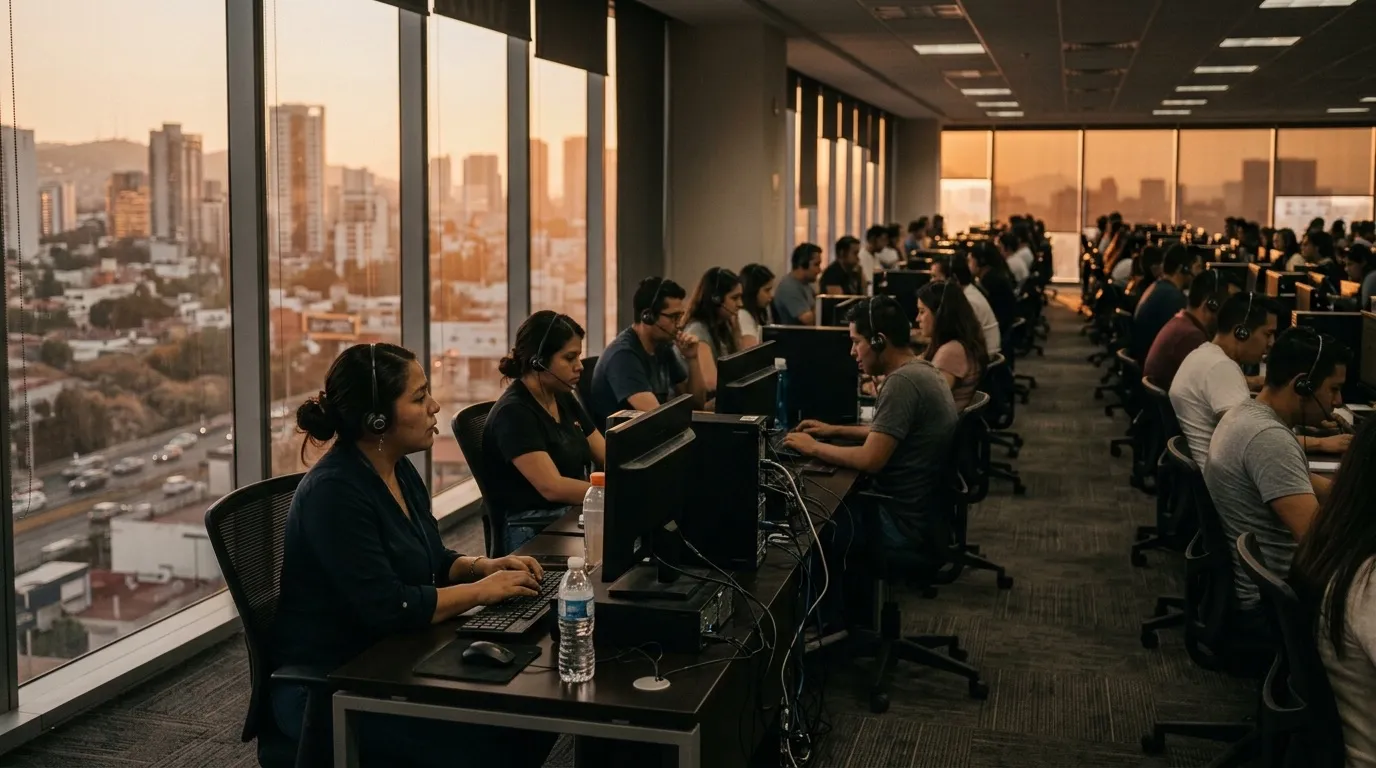
What a nearshore call center is
Onshore teams work in your own country. Offshore teams work on the other side of the world. Nearshore sits between the two: close enough to share your working day, and less expensive than hiring at home.
For US companies, nearshore usually means Mexico or Colombia, and those are the two countries we use. Both share most or all of the US working day, so supervisors, trainers and your own managers are online while the agents take calls. A problem raised at 10am gets a live answer before lunch.
The clocks are worth getting right. Mexico ended daylight saving time for most of the country in 2022. Mexico City, Guadalajara and Monterrey now stay on UTC-6 all year, which matches US Central time in winter and US Mountain time in summer. Colombia stays on UTC-5, matching US Eastern in winter and Central in summer.
Sources: Ley de los Husos Horarios en los Estados Unidos Mexicanos (Cámara de Diputados) · Hora legal de Colombia, Instituto Nacional de Metrología
What a nearshore team can handle
Nearshore teams cover the same work as a domestic floor. The best fit is work where time zone, language and judgment matter at once: a customer who switches to Spanish halfway through a billing dispute, or a technical fault that needs a same-day answer from your product team.
- Inbound customer service by phone, chat, email and social, in English, Spanish or both.
- Outbound calls: renewals, appointment setting, collections reminders and customer win-back.
- Technical support, from tier 1 troubleshooting to escalations that need product knowledge.
- Back-office work tied to live queues: order changes, claims, data entry and account updates.
Why US companies choose nearshore
Shared hours come first. Supervisors join your meetings live, training happens in real time, and process changes reach the floor the same day.
Language comes next. Mexico and Colombia both have native Spanish speakers and a deep pool of bilingual English talent, which suits US brands with Spanish-speaking customers. Test cultural fit the way you test language: on recorded calls from the agents who’d take your queue, before you sign.
Cost is the third reason. Nearshore costs less than onshore, though more than offshore. For many queues it’s the balance point: lower spend without losing the working day.
Mexico or Colombia: how we pick for each queue
Both countries work for most queues, so the choice comes down to which US hours matter most and who your callers are. We decide queue by queue, and one program can use both.
Time zone is the first filter. If your peak is the East Coast morning, Colombia lines up with it exactly in winter. If you serve the West Coast, Mexico sits closer to Pacific time all year.
Spanish is the second. Both countries have native speakers, but accent and vocabulary differ by region, and some customers notice. If most of your Spanish-speaking callers have roots in one country, put that in the brief, and we’ll test agents against your real calls.
The third is the hiring market for the skill you need, such as tier 2 tech support, collections or healthcare scheduling. We check it with partner centers in both countries before we recommend one.
| Mexico (most of the country) | Colombia |
| Time zone | UTC-6 all year, no daylight saving | UTC-5 all year, no daylight saving |
| US winter (standard time) | Same as Central; 1h behind Eastern; 2h ahead of Pacific | Same as Eastern; 3h ahead of Pacific |
| US summer (daylight time) | Same as Mountain; 2h behind Eastern; 1h ahead of Pacific | Same as Central; 1h behind Eastern; 2h ahead of Pacific |
| Good first look for | West Coast and Mountain hours; queues that also serve customers in Mexico | East Coast mornings and queues tied to Eastern hours |
Trade-offs to plan for
Nearshore is rarely the cheapest option on paper. If a queue is simple, English-only and high volume, offshore may serve it well for less.
Overnight cover is harder too. A nearshore team can run a night shift, but that cuts against the main reason to choose it. Many buyers pair a nearshore daytime team with an offshore team for nights and overflow. Just don’t send a daytime queue offshore: there, the 10am question waits for tomorrow’s handoff.
Bilingual depth varies by provider. Test it with live calls during selection, and ask how language level is assessed at hire.
Nearshore vs onshore vs offshore
Each model suits different queues, and most programs of any size use more than one. We offer onshore case by case.
| Onshore | Nearshore | Offshore |
| Relative cost | Highest | Middle | Lowest |
| Overlap with US hours | Full | Most or all of the day | Limited; suits overnight |
| Spanish-language queues | Depends on market | Strong | Limited |
| Best for | Regulated or US-resident work | Daytime, bilingual and complex queues | Overnight, overflow, high volume, back office |
How we run nearshore teams
Every team we manage runs AI triage to route each contact to the right agent, agent-assist that suggests answers during the conversation, and automated QA that scores every interaction rather than a small sample. You see the same dashboards we do, so quality problems show up in days instead of at the next quarterly review.
QA checks every call against your rules. Your counsel sets those rules, for example on call recording, consent and what agents may promise, and we turn them into lines on the scorecard.
How to choose a nearshore partner
Start with your queues. List each one with its language, hours, volume and complexity. That tells you which ones belong nearshore and which don’t.
You don’t have to move everything at once. One pilot queue, measured against targets you agree up front, tells you more than any sales deck.
- Ask which country and city each queue would run from, and why.
- Listen to recorded calls from agents who would work on your account.
- Ask how quality is measured and whether you can see the scores yourself.
- Ask how attrition is tracked and how knowledge is kept when agents leave.
- Start with a pilot queue and agree the measures that decide whether it grows.
Frequently asked questions
What does nearshore mean for a call center?
It means your agents work in a nearby country that shares most of your working day. For US companies, that usually means Mexico or Colombia. Both sit within three hours of every mainland US time zone, so supervisors, trainers and your managers are online together. We run nearshore teams in both countries through partner centers we select and manage.
How much does a nearshore call center cost?
It costs less than an onshore team and more than an offshore one. The exact price depends on the language mix, the hours you need covered, call complexity and channels. A bilingual tier 2 queue costs more than an English-only order-status line. Compare quotes for the same scope and the same service levels, or the numbers won’t tell you much.
Is Mexico or Colombia better for a call center?
Neither wins every time; it depends on the queue. Mexico stays on UTC-6 all year and sits closer to Pacific and Mountain hours. Colombia stays on UTC-5 and matches US Eastern time in winter. Both have native Spanish speakers and bilingual English talent. We pick per queue, test agents on your real calls, and one program can use both.
What time zone are call centers in Mexico on?
Most are on UTC-6 all year, including those in Mexico City, Guadalajara and Monterrey. Mexico ended daylight saving time for most of the country in 2022, so Mexico City matches US Central time in winter and US Mountain time in summer. Quintana Roo stays on UTC-5, Sonora on UTC-7, and some border municipalities still change clocks with the US.
Can a nearshore team handle Spanish and English calls?
Yes. Teams can be English-first, Spanish-first or fully bilingual. Language level is tested at hire, and AI triage routes each call by language, so a Spanish-speaking customer reaches an agent who can serve them. Ask for recorded calls in both languages before you sign, and set separate quality targets for each, because a strong English agent isn’t automatically strong in Spanish.
How good is the English of nearshore agents?
It’s good enough for your queue only if it passes your test. Language is checked at hire, but levels vary between agents and between providers. Ask to hear recorded calls from the agents who’d work your account, on calls like yours. Then put language quality on the pilot scorecard, so you judge it on real customers rather than a sales demo.
How long does it take to launch a nearshore team?
It depends on hiring, training and systems access more than on the country. A queue that needs specialist skills or long product training takes longer than a general support line. We start with one pilot queue, give you a written plan with a date for each step, and only add queues once the pilot hits the measures you agreed.
Can I combine nearshore and offshore teams?
Yes, and many programs do. A common setup runs daytime and bilingual queues nearshore, with nights and overflow offshore in the Philippines, India or Egypt. You keep one contract, one contact and one set of reports. Every team is scored the same way, so you compare quality across locations instead of trusting each site’s own numbers.