
The Cookie Stop: Launching a Premium Cookie E-commerce Brand in Mexico
We launched an e-commerce brand in Mexico for premium cookies, with a custom merchant system and 500 daily impressions after two weeks of launch.
Project Goals
Launch a professional e-commerce platform for a premium cookie brand in the Mexican market, create a simple yet powerful merchant management system, integrate with local shipping providers for reliable nationwide delivery, and establish initial market presence with rapid visibility growth.
The Challenge
Launching a premium food e-commerce brand in Mexico isn't like launching one in the US. The market is different, consumer behavior is different and, above all, the logistics are completely different.
Our client had a clear idea: premium artisan cookies delivered fresh across Mexico. But they faced the same realities every Mexican e-commerce startup faces.
Shipping is complicated. Mexico has no single dominant carrier the way the US has USPS or FedEx. Instead, you deal with multiple regional carriers, each with its own pricing, coverage, reliability and integration requirements.
Payments have friction. Mexican shoppers pay differently from US shoppers. Cash on delivery is still common, and card use varies by region, so a store has to support several payment options or lose sales.
Trust takes time. A premium product needs a presentation that matches. The website had to signal quality, reliability and professionalism from the first visit.

They needed an e-commerce setup built for the Mexican market, not a US platform awkwardly translated into Spanish.
What We Built
We built an e-commerce platform that handles everything from product browsing to doorstep delivery, with each system designed around how Mexican e-commerce actually works.
The Storefront
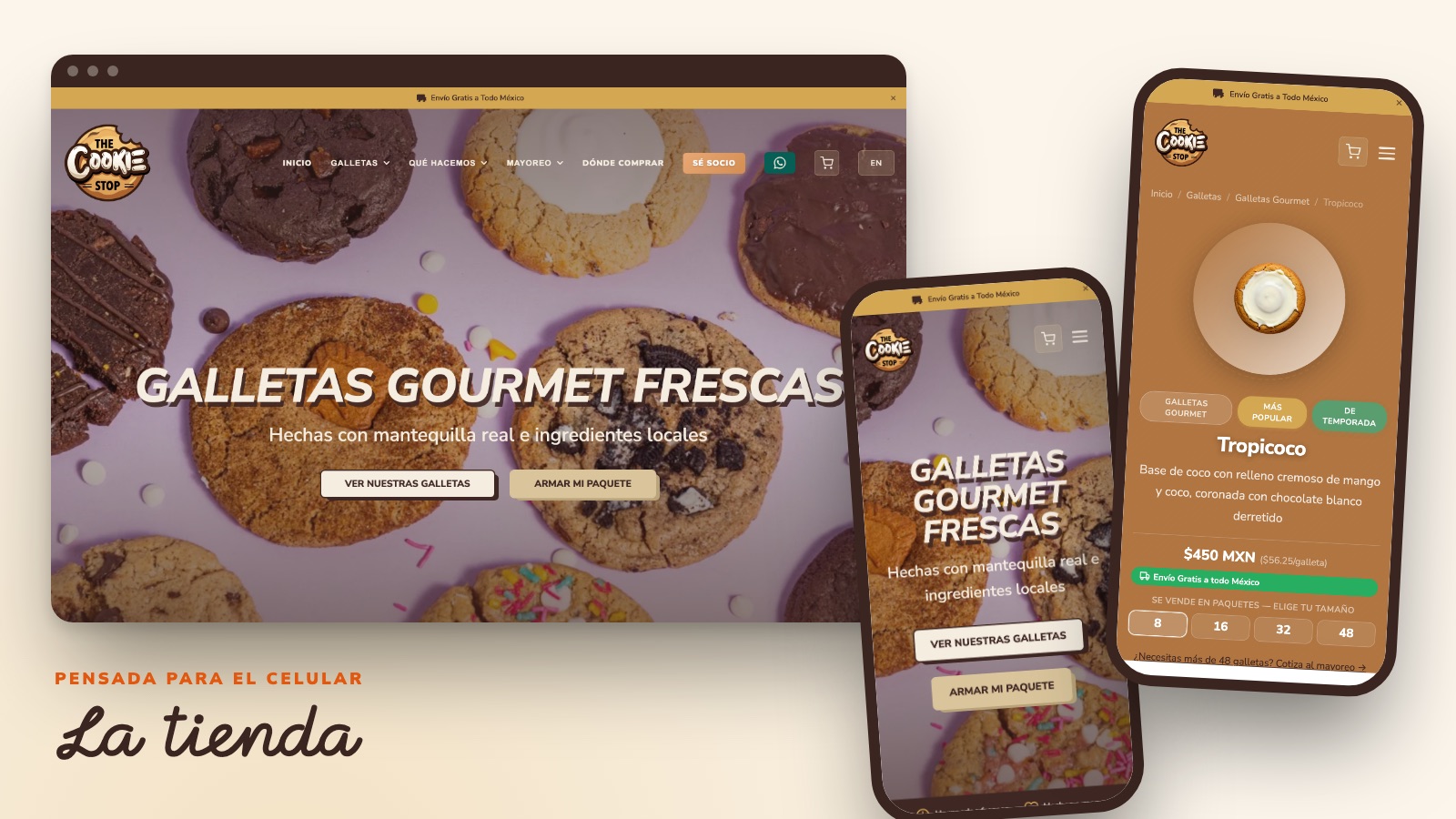
The design is clean and mobile-first, and it puts the product at the center.
The site works well on any device, which matters when most Mexican shoppers buy from their phones. Pages load quickly even on slower connections, because plenty of customers don't have fiber at home.
Product pages are built to convert, with high-quality photos, clear descriptions, transparent pricing and obvious calls to action.
Custom Merchant System
Off-the-shelf e-commerce platforms are capable, but they're built for every market at once. This business needed something tailored to how it runs.
We built a lightweight merchant management system that handles three areas.
Inventory Management
- Real-time stock tracking across cookie varieties
- Low-stock alerts to prevent overselling
- Batch tracking to rotate fresh product
- A simple interface for updating availability
Order Processing
- One dashboard showing every order
- An order status workflow (pending → confirmed → preparing → shipped → delivered)
- Automatic customer notifications at each stage
- Simple handling of changes and cancellations
Customer Management
- Order history
- Delivery address management
- Customer notes and preferences
- Identification of repeat orders
The system has what a small e-commerce operation needs and leaves out what it doesn't.
Shipping Integration
This was the feature the business depended on. Mexican carriers differ in coverage, pricing and API integration methods.
So we integrated with Mexican shipping aggregators that connect to multiple carriers at once.
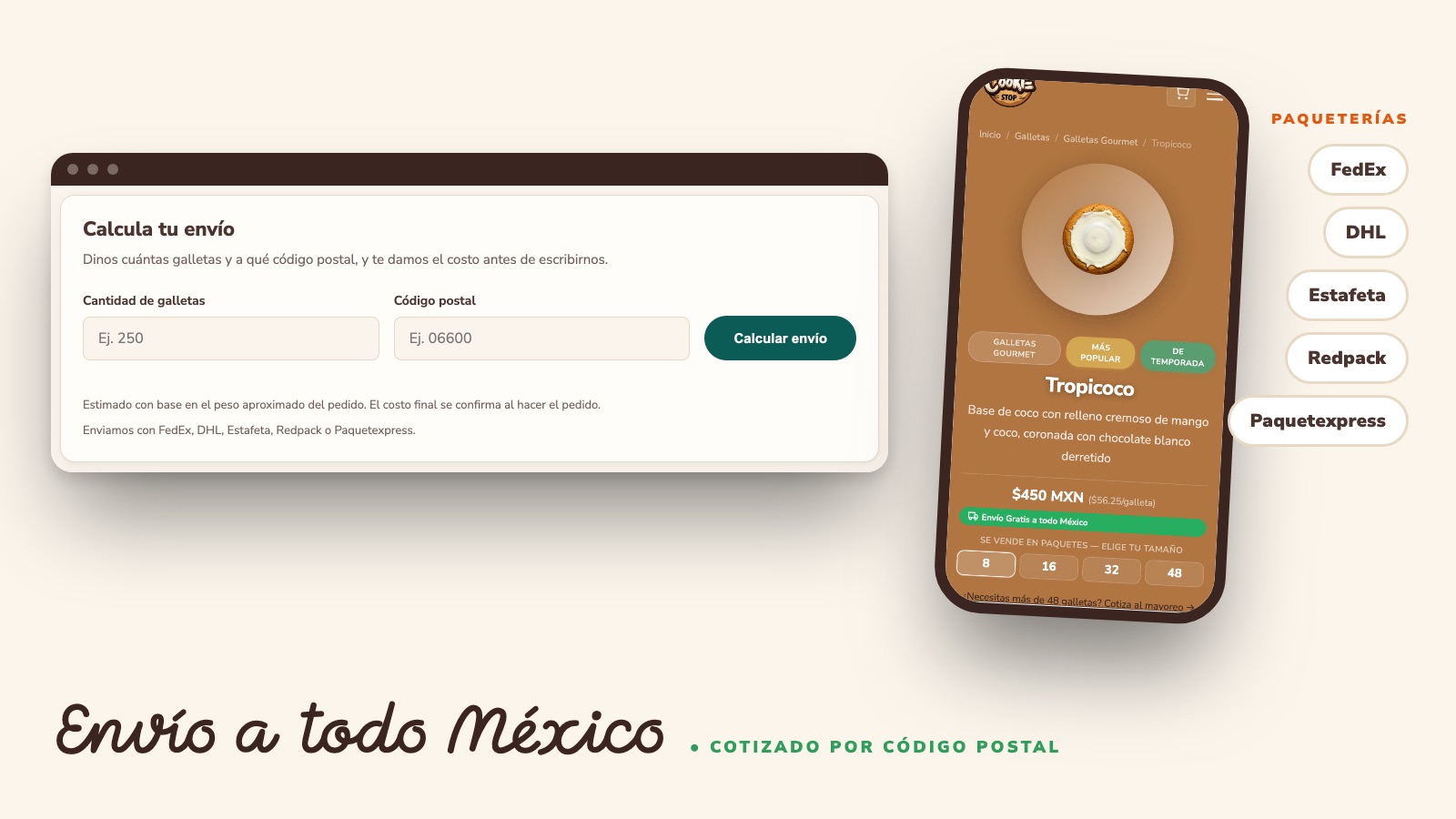
Multi-Carrier Access Instead of integrating with each carrier separately, we connected to aggregators that provide access to:
- Estafeta
- DHL Mexico
- Redpack
- Paquetexpress
- Several regional carriers
One integration gives the store access to all of them.
Automatic Rate Calculation The customer enters a postal code, and the site shows the available shipping options with real prices from multiple carriers. There are no manual rate cards and no guesswork, because pricing is calculated from weight, destination and carrier availability.
Label Generation Shipping labels are generated automatically when an order is confirmed. One click creates the label with all required information filled in, so nobody re-types addresses or fixes formatting errors.
Tracking Integration Tracking numbers are collected automatically, and customers get their tracking information as soon as the package ships. Status updates come from carrier APIs and appear in the customer's account.
Coverage Optimization The aggregator picks the best carrier for each destination based on coverage, price, estimated delivery time and reliability ratings. A city address might go with one carrier and a rural address with another, and the system handles that on its own.
The Launch Strategy
Building the platform was half the job. Getting initial traction was the other half.
SEO Foundation
We launched with proper technical SEO from day one:
- Clean URL structure
- Optimized product pages
- Fast loading speeds
- Mobile optimization
- Structured data markup
- XML sitemap
- Google Search Console integration
The launch didn't depend on expensive ads. It relied on a solid technical foundation and content that search engines could find and understand.
Local Search Optimization
We focused on location-specific searches such as:
- "Galletas artesanales México"
- "Cookie delivery [city name]"
- "Galletas gourmet entrega a domicilio"
That put the store in front of people already searching for what it sells.
Social Media Integration
We connected the website to the brand's social channels:
- Instagram shopping integration
- Facebook pixel for retargeting
- WhatsApp contact integration, which is essential in Mexico
- Social sharing on product pages
That made it easy for early customers to share the brand and spread the word.
The Results
500 daily impressions after two weeks of launch. The site went from no search visibility to steady daily impressions through solid technical work and targeted optimization.
Fast, reliable nationwide shipping infrastructure. From day one, customers anywhere in Mexico could get real shipping quotes at checkout and track their orders. Nobody had to wait for an email with shipping costs or ask whether a product was available.
Custom merchant system for inventory and order management. The merchant system made the business manageable without hiring a technical team. Orders come in, the system processes them, labels print and customers get notified.
Integration with Mexican shipping aggregators. One integration covers multiple national and regional carriers, chosen per destination.
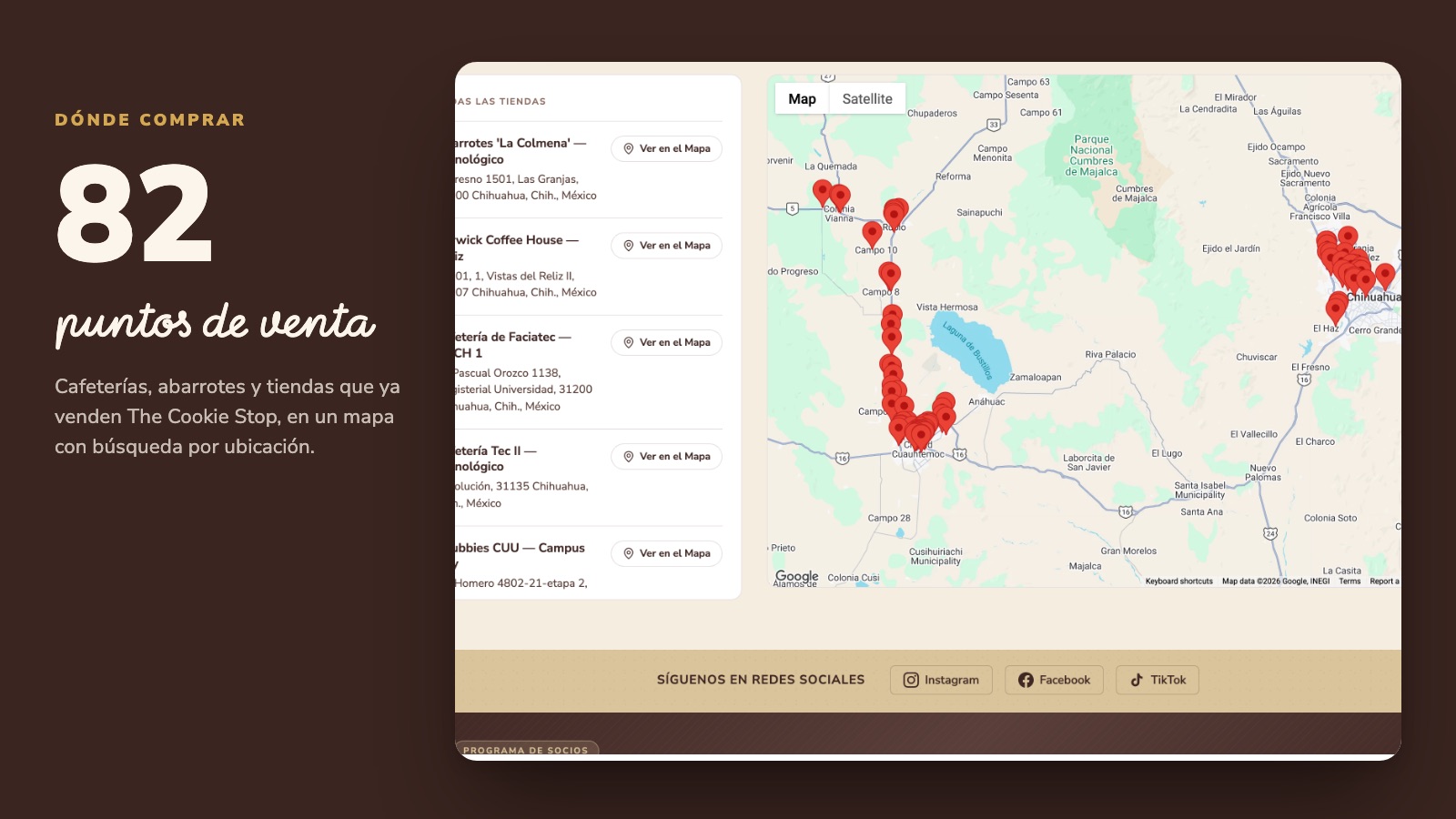
The site looks like an established brand rather than a startup experiment, and a premium product needs exactly that.
Technical Implementation
Platform Foundation
- Built on a modern e-commerce framework
- Hosted on reliable infrastructure
- SSL encryption for secure transactions
- GDPR and Mexican data protection compliance
Payment Processing
- Multiple payment gateway integration
- Credit and debit card processing
- OXXO payment support, essential in Mexico
- Secure tokenization for saved cards
- Automatic fraud detection
Shipping Architecture
- REST API integration with shipping aggregators
- Real-time rate calculation engine
- Automatic carrier selection logic
- Automated label generation
- Webhook-based tracking updates
Analytics & Tracking
- Google Analytics 4 implementation
- E-commerce event tracking
- Conversion funnel analysis
- Customer journey mapping
- Search Console integration for SEO monitoring
What We Learned
Local market knowledge is non-negotiable. You can't translate a US e-commerce playbook into Spanish and expect it to work in Mexico. Payment methods, shipping and shopping behavior are all different, so the solution has to be built for this market.
Shipping integration makes or breaks food e-commerce. Premium cookies need reliable, trackable delivery. Without an integrated shipping setup, someone ends up managing logistics by hand, and that doesn't scale.
Simple systems win. The merchant system has exactly what's needed and nothing more. Complex systems need training and maintenance, while simple ones get used.
Mobile-first isn't optional. When most Mexican shoppers buy from their phones, a site that doesn't work well on mobile loses most of its potential customers.
Fast visibility is possible with good foundations. Reaching 500 daily impressions after two weeks of launch came from solid technical SEO and targeted content, with no paid ads. The work was making the site easy for search engines to find and understand.
Integrations should be future-proof. Because the store uses shipping aggregators instead of individual carrier APIs, adding a new carrier is simple, and the infrastructure grows without a rebuild.
The Cookie Stop went from concept to a working e-commerce business, on a foundation that supports growth as the business scales.
Want to launch your e-commerce brand? Let's talk →
See how we build for growth View case studies →
Like what you see?
Tell us what you're building and we'll tell you how we'd approach it.
Start a project