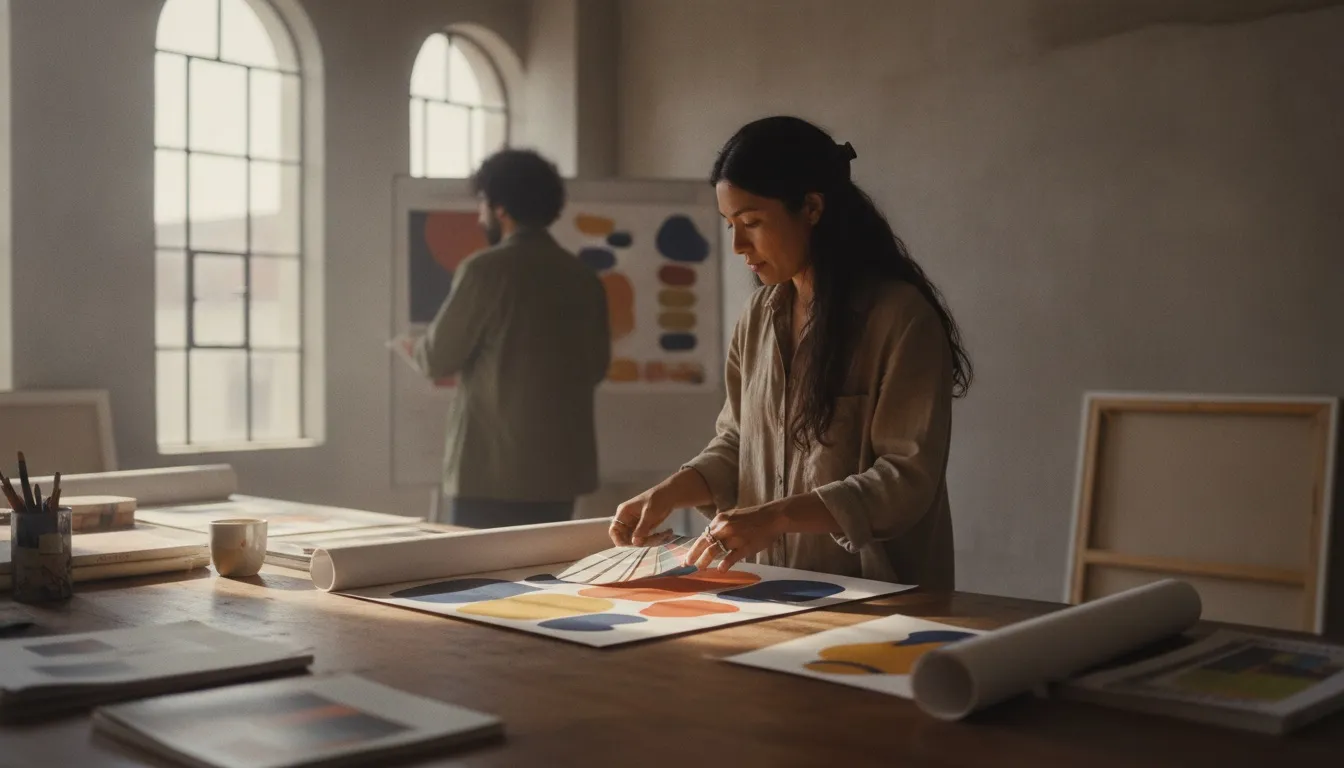
A graphic designer comparing printed color swatches and poster proofs on a large table in a Mexico City studio, natural window light

/Nearshore · Graphic Design

Nearshore graphic design for work that needs a conversation.

Nearshore graphic design puts your designers in Mexico or Colombia, in time zones that share most of the US working day. That matters most when the work is still being decided: a new campaign concept, a sales deck for a big pitch, or creative for Spanish-speaking customers. This guide covers which design work suits the model, why live feedback changes the result, how to keep ownership of every file and when offshore is the better fit. For the service itself, see our graphic design outsourcing page.

What nearshore design means

A nearshore designer works from a neighboring country, during your business day, inside your brand system and your design tools. For US companies the two strongest locations are Mexico and Colombia, and the clock is a big part of the reason.

Mexico’s time-zone law, published in October 2022, ended daylight saving time for most of the country. Mexico City, Guadalajara and Monterrey stay on UTC-6 all year, which matches US Central in winter and Mountain in summer. Some northern border areas keep a different schedule.

Colombia stays on UTC-5 all year, matching US Eastern in winter and Central in summer. A designer in either country is online while your marketing team is, so a comment left at lunch can be in the next draft that afternoon.

Sources: Mexico, Ley de los Husos Horarios (Cámara de Diputados) Colombia legal time, Instituto Nacional de Metrología

Design work that fits nearshore

The model earns its place on work where the brief changes as you look at it. A nearshore designer usually takes on:

  • Campaign concepts: two or three directions, reviewed live, then one taken to final.
  • Brand-sensitive pieces such as launch creative, trade show graphics and anything your CEO will see first.
  • Sales and pitch decks where the story is still moving the week before the meeting.
  • Packaging and label design for new products, where legal copy and structure change late.
  • Spanish and bilingual creative, including work for US Latino audiences.
  • Website and landing page visuals built alongside your web or marketing team.

Why live feedback changes creative work

Production design can wait for a written answer. Concept work can’t, or not without losing days. A first round of concepts nearly always raises questions that are faster to settle in a ten-minute call than in a thread of comments.

With shared hours, your marketing lead can share a screen, point at a layout and say what feels wrong. The designer adjusts while you watch, or sends a revision before the end of your day. Each round takes hours instead of a night.

Fewer, shorter rounds also protect the brand. When feedback arrives as a long written list, designers tend to fix each point literally. A conversation surfaces the reason behind the comment, and the next draft solves the real problem.

Spanish, bilingual and US Latino creative

Translating a finished ad into Spanish rarely works. Line lengths change, idioms fall flat and imagery chosen for one audience can read differently to another. Designers in Mexico and Colombia work in Spanish natively and can flag those problems before a piece ships.

US Latino audiences aren’t one market, and Mexican and Colombian Spanish differ in vocabulary and tone. Match the designer’s background to the audience where it matters, and keep a native reviewer on your side for copy.

Bilingual designers also make it simpler to run one campaign in two languages from the same files, so the Spanish version isn’t a late, rushed copy of the English one.

The brand system comes first

Shared hours don’t replace a brand system. A designer working from current guidelines, a template library and an organized asset library will stay on brand. Without them, every brief becomes a new interpretation of your brand.

If you don’t have that system yet, build it before you scale production. Defining a brand is a strategy and identity project, not a production task, and it’s a different kind of engagement.

  • Guidelines that are current: logo use, color, type, imagery and tone, with examples of right and wrong.
  • Templates for the formats you produce every month: social posts, ads, decks and one-pagers.
  • An asset library with approved logos, photos and icons, versioned and in one place.
  • A named approver on your side who can say yes or no without a committee.

Who owns the files

Under US copyright law, design commissioned from an outside firm is usually not a work made for hire. That status applies to commissioned work only in nine categories and only with a written agreement signed by both sides. Otherwise the creator owns the copyright, so your contract should assign it to you in writing.

If anyone uses AI image tools, ask for it to be disclosed. The US Copyright Office registers only human authorship, and AI-generated material that is more than minimal must be identified when you register a work. Then put the rest of ownership in writing:

Sources: US Copyright Office, Circular 30: Works Made for Hire US Copyright Office, guidance on works containing AI-generated material

  • The contract assigns copyright in the work, including source files, to your company.
  • Fonts and stock images are licensed in your company’s name, so the license stays with you.
  • Work happens in a design workspace your company owns, such as Figma or Adobe, with named seats for each designer.
  • Source files are filed in your asset library as work is approved, not handed over at the end.
  • Access is removed the day a designer leaves your account.

Nearshore compared with onshore and offshore

Many marketing teams use more than one model for different kinds of design. Here’s how the three compare.

Onshore (US)Nearshore (Mexico, Colombia)Offshore (Philippines, India, Egypt)
Relative costHighestMiddleLowest
Shared hours with your teamFullMost or all of the dayLimited unless the team works night shifts
Feedback roundsLiveLive, same dayOvernight, through written briefs
Spanish and US Latino creativeSmall pool, high costNativePoor fit
Best forIn-person shoots and on-site brand rolesConcepts, decks and brand-sensitive piecesProduction from an established brand system

When offshore is the better fit

Nearshore isn’t the answer for every design request. Offshore usually wins when the work follows an established brand system and doesn’t need your input to finish.

Think of resizing one approved ad into twenty formats, filling social templates, formatting decks, retouching product photos or preparing print-ready files. If the brief is complete and the template exists, the work can run overnight and be waiting in the morning.

Many teams split the work: offshore for production volume, nearshore for concepts and anything that needs a conversation.

How to start

Start with one stream of work, not your whole creative calendar. Here’s the sequence we’d use.

  1. Scope List the formats you produce each month, the tools you use and who approves the work.
  2. Gather the system Guidelines, templates and the asset library, even if they’re incomplete.
  3. Set up ownership Workspace seats in your name, licenses in your name and an IP assignment in the contract.
  4. Run a trial project One campaign or one deck, with live reviews, before you commit to ongoing work.
  5. Capture the rules Write down every brand decision made in feedback, so the system improves as you go.

What to ask a nearshore design provider

Shared hours are the starting point, not the difference. These questions show how a provider will actually handle your brand.

  • Which country and city would the designer work from, and which hours exactly?
  • Can you see three consecutive weeks of ordinary work for one client, not just portfolio highlights?
  • How are revision rounds counted, and who decides when a piece is final?
  • Does the contract assign copyright and source files to you, and in whose name are fonts and stock licensed?
  • What happens when your usual designer is out during a launch?

Mexico, Colombia or both

OTRO provides and manages designers in Mexico and Colombia under one contract, working inside your brand system and your tools. For the service itself, including what the designers produce and how briefs and reviews run, see the graphic design outsourcing page. If design is one part of a wider plan, the marketing and website pages show how it connects.

Frequently asked questions

What is nearshore graphic design?

It’s design work done by designers in a nearby country who work during your business day. For US companies that usually means Mexico or Colombia. The designers work inside your brand guidelines and design tools, join live reviews and handle concepts, decks, campaign creative and bilingual work, with files delivered to your own asset library.

What is the difference between nearshore and offshore design?

Time zone, cost and the kind of work. A nearshore designer in Mexico or Colombia shares most of your day, so concept rounds and feedback happen live. An offshore designer in the Philippines, India or Egypt usually costs less but works while you sleep, which suits production from templates and written briefs. Many teams use both.

How much does nearshore design cost?

It usually costs less than a US designer or agency and more than an offshore team. The price depends on volume, the mix of concept and production work and how much context the designer needs, so we quote per scope rather than with one rate. Sharp briefs and a current brand system lower the cost on any model.

Can a nearshore designer create Spanish-language ads?

Yes, and it’s one of the strongest reasons to choose the model. Designers in Mexico and Colombia work in Spanish natively, so layouts are built for Spanish line lengths rather than squeezed after translation. Match the designer’s background to your audience where it matters, and keep a native speaker on your side approving the copy.

How do we make sure we own the designs and source files?

You should, and the contract should say so. In the US, commissioned design usually isn’t a work made for hire, so ask for a written assignment of copyright and source files. Buy fonts and stock in your company’s name, and keep work in a design workspace your company owns, with a named seat for each designer.

Should we fix our brand guidelines before outsourcing design?

If you have no guidelines at all, yes. A designer can’t stay on brand when nobody has decided what the brand is. If your guidelines are thin or out of date, you can start anyway: the first weeks of feedback will reveal the missing rules, as long as someone writes them down.

Plan your design delivery model

Tell us what you design each month, which tools you use and what’s been hard to get right. We’ll come back with a written plan: what suits nearshore, what could run offshore and how reviews will work.

Get a design plan