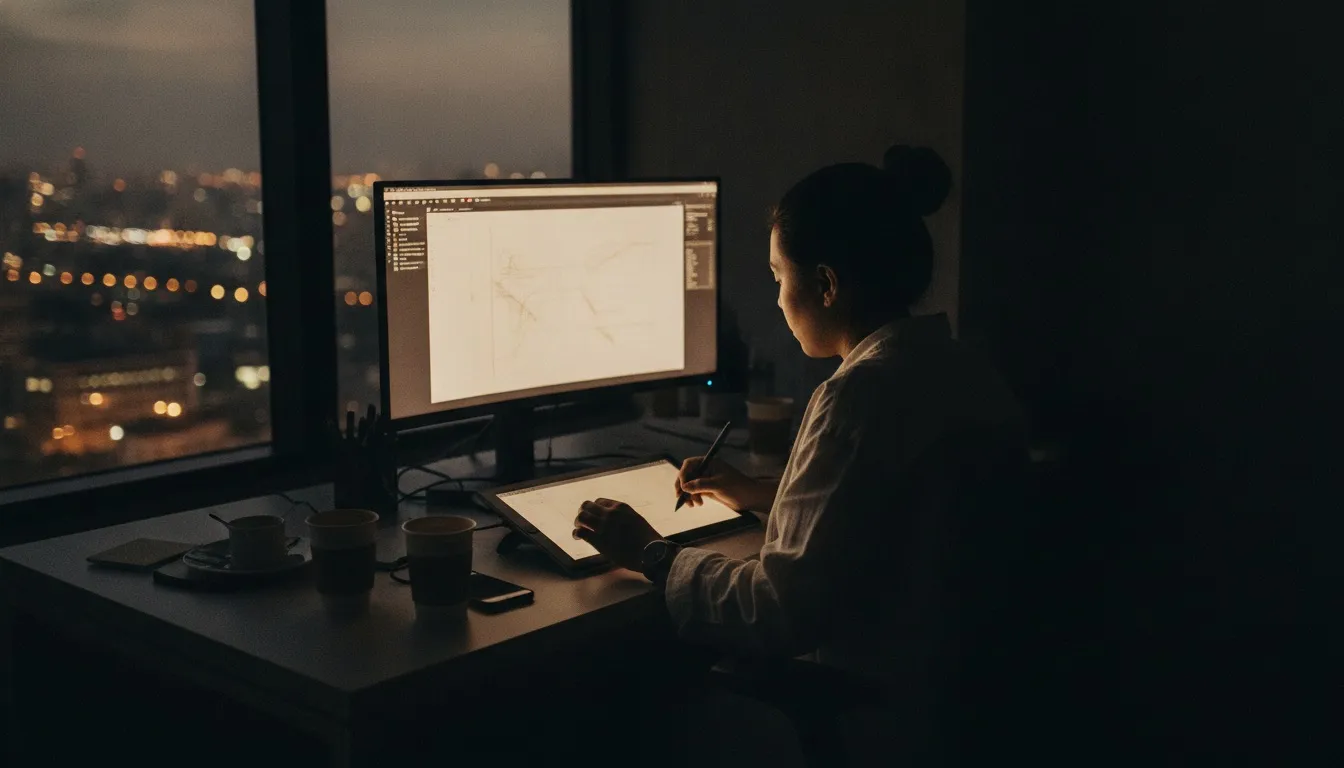
A designer working with a pen tablet at a desk late in the evening in a Manila office, monitor glow and city lights through the window

/Offshore · Graphic Design

Offshore graphic design that runs on your brand system.

Offshore graphic design places your designers in a distant country, usually at the lowest cost of the three delivery models and on a different working day. It works best for production design: taking an approved look and applying it across formats, sizes and channels. This guide covers which design work suits the Philippines, India and Egypt, how overnight briefs run, how to keep ownership of every file and when nearshore is the better choice. For the service itself, see our graphic design outsourcing page.

What offshore design means

An offshore designer works from a country many hours away, inside your design tools, on briefs you’ve written down. Each of the three common locations brings something different.

The Philippines is on UTC+8 with no daylight saving, 12 or 13 hours ahead of US Eastern, and has a large English-speaking workforce. India is on UTC+5:30, also with a large English-speaking workforce. Egypt is on UTC+2, or UTC+3 in summer, and adds Arabic alongside English.

The designer either works their own daytime, which is your night, or a shift aligned to part of your day. Either way, far fewer hours overlap with your marketing team than with a nearshore designer.

Source: IANA Time Zone Database

Production design, not concept work

Design work splits into two kinds: creative work decides what something should look like, and production work applies a decision you’ve already made to a new size, channel or product.

Offshore is strongest on production, and the first benefit is cost, since it’s the lowest-cost of the three models. The second is time: briefs sent at the end of your day come back as finished files by morning. The third is scale, because adding a designer for a seasonal campaign is practical when the templates already exist.

Concept rounds are a different story. When the answer isn’t written down yet, a night between each round of feedback adds up quickly.

Design tasks that suit offshore

Offshore works best where the look is already decided, and the more complete the template, the better the fit.

TaskOffshore fitWhy
Ad resizes and variantsStrongOne approved master, many formats, easy to check
Template-based social postsStrongLayout, type and color are fixed; only content changes
Presentation formattingStrongApplying a master deck to your team’s drafts
Photo retouching and clippingStrongClear specs for background, crop and color
Packaging adaptationsGoodNew sizes or variants of an approved design
Print-ready filesGoodBleed, color and printer specs written in the brief
New campaign conceptsWeakNeeds live feedback and judgment on your brand

The brand system makes it work

An offshore designer can only be as consistent as the system they work from, and the less they have to interpret, the fewer corrections reach your inbox.

  • Current guidelines with examples of right and wrong, not just rules.
  • Templates for every recurring format, with locked brand elements and editable content areas.
  • An asset library with approved logos, photos and icons, versioned and in one place.
  • Export specs per channel: sizes, file types and naming, so files drop straight into your tools.
  • A list of past corrections, so the same mistake isn’t fixed twice.

How overnight design and written briefs work

Offshore design runs on handoffs, not calls. Here’s a typical cycle for a US marketing team working with a designer in the Philippines.

  • End of your day Your team approves yesterday’s files, answers open questions and adds new briefs to the queue.
  • Overnight The designer works the queue against the templates and specs. Anything a brief doesn’t answer goes on a question list, not into a guess.
  • Before your morning Finished files are in your asset library, with a handoff note listing what’s done and what’s waiting.
  • Your morning Your approver reviews, comments in writing and updates the brief or template where a rule was missing.

Writing briefs that survive the time difference

With a night between each question and answer, the brief does the work a conversation would. A good production brief covers:

  • The master file or template to start from, linked, not attached.
  • Every size and format needed, with channel specs.
  • Final copy, already approved, in every language required.
  • What can change and what can’t, such as logo position or product photo.
  • The deadline in the designer’s time zone as well as yours.

Files, fonts, workspaces and ownership

Under US copyright law, design commissioned from an outside firm is usually not a work made for hire. That status applies to commissioned work only in nine categories and only with a written agreement signed by both sides. Otherwise the creator owns the copyright, so your contract should assign it to you in writing.

If anyone uses AI image tools, ask for it to be disclosed. The US Copyright Office registers only human authorship, and AI-generated material that is more than minimal must be identified when you register a work. Then set up the rest:

Sources: US Copyright Office, Circular 30: Works Made for Hire US Copyright Office, guidance on works containing AI-generated material

  • The contract assigns copyright in the work, including source files, to your company.
  • Fonts and stock images are licensed in your company’s name, so the license stays with you.
  • Work happens in a design workspace your company owns, such as Figma or Adobe, with named seats for each designer.
  • Files live in your own storage, not personal drives or chat apps.
  • Access is removed the day a designer leaves your account.

When nearshore is the better fit

Fewer shared hours mean slower answers to new questions. In design, that bites hardest when the look isn’t decided yet. Keep these closer to home:

  • New campaign concepts and anything that needs two or three directions reviewed live.
  • Brand-sensitive pieces: launches, pitch decks and work your leadership will see first.
  • Spanish and US Latino creative. Mexico and Colombia offer native Spanish during US hours.
  • Packaging for new products, where legal copy and structure change late.
  • Any work where the brand rules only exist in someone’s head. Write them down first, then move it.

Offshore compared with nearshore and onshore

Cost falls as distance grows, and so do shared hours with your team. Here’s how the three models compare for design work.

Onshore (US)Nearshore (Mexico, Colombia)Offshore (Philippines, India, Egypt)
Relative costHighestMiddleLowest
Shared hours with your teamFullMost or all of the dayLimited unless the team works shifts
Brand system neededLightModerateComplete and kept current
Language profileNative EnglishNative Spanish, bilingual EnglishEnglish; Arabic from Egypt
Best forIn-person shoots and on-site brand rolesConcepts, decks and bilingual creativeResizes, templates, retouching and print files

Blending offshore with nearshore

Many marketing teams run design better blended: nearshore for concepts and anything that needs a conversation, offshore for production once a look is approved. OTRO provides and manages designers in both models under one contract, so work can move between them as a campaign goes from concept to rollout.

Frequently asked questions

What is offshore graphic design?

It’s design work done by designers in a distant country, such as the Philippines, India or Egypt, usually at the lowest cost of the three delivery models. The designers work from your brand system and written briefs, often overnight, and deliver finished files to your asset library with a handoff note for your morning review.

Which design work should not go offshore?

New campaign concepts, brand-sensitive launches, pitch decks still being written and Spanish-language creative. That work needs live feedback, or native cultural judgment, more than it needs low cost. Keep it with a nearshore or in-house designer, and send the production that follows, such as resizes and template work, offshore.

How much does offshore design cost?

Offshore is usually the lowest-cost of the three models, followed by nearshore, then onshore. The price depends on volume, the formats involved and how complete your templates are, so we quote per scope. Don’t compare on rate alone: a designer who sends every file back for correction isn’t cheap.

Can offshore designers work US hours?

Some can, on night shifts, but production design rarely needs it. Most of the value comes from overnight work with a clear brief and a good handoff note. If your design work needs live reviews during your day, a nearshore designer in Mexico or Colombia is usually the better fit.

How do we keep offshore designs on brand?

Give the designer a complete system: current guidelines with examples, templates with locked brand elements, an approved asset library and export specs per channel. Write briefs that answer every question in advance, review a sample of each batch, and add each correction to the guidelines so the same mistake doesn’t come back.

Can we own the designs an offshore team makes?

Yes, and the contract should say so. In the US, commissioned design usually isn’t a work made for hire, so ask for a written assignment of copyright and source files. License fonts and stock in your company’s name and keep work in a design workspace your company owns, with named seats.

Find the right home for your design work

Tell us what you design each month, which templates exist and which tools you use. We’ll come back with a written plan: what could run offshore, what should stay nearshore and how reviews will work.

Get a design plan